

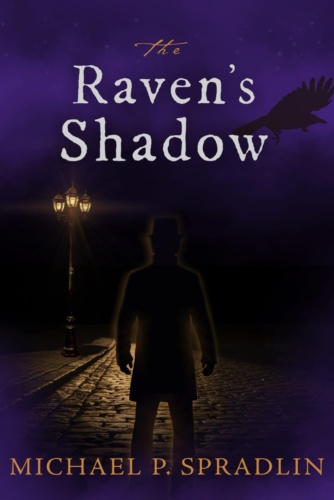
The Raven’s Shadow
A book for Older Kids
Washington DC, 1824.
A new president is about to be sworn in after a contentious election. Among the celebrants who descend upon the city, are three young men from different backgrounds, arriving there for different reasons. Unknown to them, an evil presence has also made its way to the capital. A presence that will one day be revealed to the world as a powerful and ancient evil. And he aims to destroy the young republic. His name is Count Dracula.
These three young men, Edgar Allan Poe, Charles Darwin and Abraham Lincoln must join together and stop the count before he wreaks havoc on the new nation. With the help of a mysterious stranger named Reynolds Van Helsing, this team of heroes uncovers the Count’s deadly plot. Only time will tell if they can muster the strength to stop a nearly unstoppable force before it destroys them all.
Read an Excerpt
Enjoy an Excerpt
↓ Jump to Ordering Options
The boundaries which divide life from death are at best shadowy and vague. Who shall say where the one ends, and where the other begins?—Edgar Allan Poe
A man’s friendships are one of the best measures of his worth.— Charles Darwin
You cannot fail, if you resolutely determine that you will not.—Abraham Lincoln
Chapter One
On A Midnight Dreary
Early spring 1824
I willed the world to stop spinning as my head hung over the railing of the ship. Seasickness exhausted me, and there was little left in my stomach. My desire to seek fresh air out on the deck was a grave miscalculation. Upon our departure from Whitby Heights, Captain Swales assured me time and again that the Atlantic was “calm” this time of year, but our voyage was beset by unpredictable weather from the first. I focused on the water’s surface, trying to distract myself by watching the vessel’s hull cut through the water.
The HMS Demeter was a three-masted schooner. Under full sail, she ran at nearly twenty knots, a sleek, fast ship that hurled over the waves, like a gazelle leaping across the African plains. We departed Whitby Heights four weeks ago; the trip was tempestuous at best. Once I returned to England, I vowed never to travel by ship again. There would always be solid ground beneath my feet.
Watching the ship’s wake made the dizziness worse, and I lifted my gaze, trying to find the horizon point in the thickening gloom of night. My heart sank, for ahead of us another dark curtain of clouds descended from the sky to the ocean’s surface. Lightning danced across the waves. There was a full moon behind the clouds, and enough light showing through for me to see the swells gathering as the gale grew in force.
I jumped at the feel of a hand on my shoulder, staggering to my feet to face Captain Swales, his ever-present pipe giving his face an odd orange glow.
“Feeling ill again, Master Darwin?” he asked with the slightest hint of disdain. My father paid my passage to America as a “gift” for my impending birthday. Though I lacked any desire to travel to the colonies, he insisted. I was the only passenger aboard who wasn’t sharing a cabin and as such, the captain, who was in his early twenties, treated me as a wealthy, spoiled dilettante and even an object of subtle ridicule. My father threatened to withhold me from the academy I wished to attend when I returned to England. Getting away from our estate, away from him, was all I could think of. If it took a dreadful trip to a place I had no desire to see, I considered it a small price.
“I’m afraid so, Captain Swales,” I answered, and sought to change the subject. “Another storm ahead?”
“Aye. We’ll run around it, don’t you worry, laddy. But ’tis apt to get rough, and the deck is no place for a passenger when there’s wind like this about.”
Captain Swales was a Yorkshireman, born and raised in Whitby, a seaport on the Yorkshire coast. He spoke with a thick brogue, and it took several days of intense concentration for me to understand him.

“Just a while longer,” I pleaded. “The fresh air is doing me wonders.”
Not true. Not true in the slightest, but I could not bear the thought of returning to my small, stifling quarters below. Though it was March, and the temperature was cool, the cabin offered little in the way of circulation. With the fact I was so often ill there, I avoided it all costs, except to sleep.
Captain Swales muttered to himself and kept his eye on the approaching storm. The close proximity to pipe smoke was not improving my condition and as the waves strengthened, I felt my stomach lurch again in awkward anticipation of another bout of sickness. Bile rose into my throat and mouth but this time, I managed to choke it back down.
The ship was tacking at an angle, making every effort to avert the storm, but it continued toward us, as a cat might chase a scurrying mouse. Realizing we could not outrace it, we changed course again, the crewman on the quarterdeck behind us spinning the wheel and running directly at the oncoming waves. The first of them lifted the ship and brought it down again, the cold water rushing over us, stinging our faces like a swarm of bees. Lightning crackled and the skies opened, sending a deluge of rain to join the ocean water crashing about the deck.
“Master Darwin, I must insist you return to your cabin,” Captain Swales’ pipe sizzled, extinguished by the rain and he tapped the bowl empty while bending his legs to and fro as the ship rose and fell. As lightning lit up the sky again, the captain’s face was illuminated quite clearly for a few brief seconds. There was a small smile on his face and nothing of the ship’s violent path through the roaring wind and water fazed him.
In the receding glow of the flash, I observed a white cloth bandage encircling the captain’s throat. Two dark spots, which I assumed where blood, leaked through.
“Captain! Are you injured?” I shouted, over the noise of the thundering waves and roaring wind.
“What? Oh, this,” he said, scratching at his neck. “It’s nothing. Just a small wound. I’m not even sure how it happened. I’m afraid there is no more time for talk now, laddy. You need to make your way below.”
Sheets of lightning rippled through the clouds above us, again and again, giving an eerie flickering incandescence to the deck. The crewman at the ship’s wheel on the quarterdeck above us caught my eye. It was the third mate, a man named Dunsmore.
A long tentacled arc of lightning struck near the starboard bow, and in the instantly too-bright light, I could see someone standing behind Dunsmore, peering over his shoulder. Was it another member of the crew? Or another passenger ventured onto the deck? It was no one I recognized, and all I could discern was that whoever stood there possessed uncommonly pale skin, almost chalk-like in pallor. His eyes glowed an unearthly red. Dunsmore was oblivious to his presence.
The lightning faded and the world went dark, and then thunder sounded like a thousand cannons. And it might have been my ears deceiving me, but over the noise, I thought I heard a man cry out in surprise and agony.
The captain acted as if he heard nothing. And if the ship did not lurch starboard, we may not have realized what was happening until it was too late. The sky crackled with light again, and this time, both the captain and I glanced up at the quarterdeck to find the wheel abandoned and Dunsmore vanished.
“Captain!” I shouted, pointing at the wildly spinning wheel.
“Dear God in heaven!” Captain Swales sprang to action, scurrying across the deck, bending with the waves. “Dunsmore! Where are you lad?” he shouted, racing up the ladder and flinging himself at the wheel. In just a few short seconds, the wind pushed the ship in the absolute wrong direction. I looked to starboard and blanched at the site of a large wave about to hit the ship broadside.
“Master Darwin, hold on!” the captain shouted. I thrust my hands through the railing again, wrapping my arms through the spindles and squeezing them as tightly as I could.
The wave blasted into the ship and water sprayed in all directions, most of it coming straight across the deck in a knee-high surge, pressing me hard against the railing. I braced myself and prayed the shipbuilders did not skimp on their construction of the fencing enclosing the deck. The ship rocked up on its port side and I found myself spitting out water and trying to breathe. Higher and higher, the starboard side rose as the port side sank in the trough of the wave. We teetered there for an eternity, and I found myself thinking my life would end here in this wretched ocean.
Held fast by the railing, I was almost parallel to the surface of the water, desperately willing the ship to settle. To my absolute dismay, one of the railings I clutched in my hand snapped off, but the rest held. Finally, the ship tipped back to starboard.
The churning waves left me confused, and I lost sight of the captain, but then I heard him shouting orders. “Man overboard! Man overboard! All hands to your stations, lads!”
Three sharp blasts of the captain’s whistle pierced the air. He steered the ship into the storm, so we rode perpendicular into the waves again, momentarily at least, less likely to capsize.
“Master Darwin,” he shouted. “You need to go below at once.” As his command reached me, several of the ship’s crew bounded out of the gangway and went immediately to their duties. With a lurching gait, I crossed the deck and went through the door, stumbling down the stairs to the corridor below.
My cabin was halfway down the passageway, on the starboard side of the ship, and given the events of the last few minutes, I was eager to arrive there. Flickering oil lamps lining the walls lighted the way to my quarters. I stretched out my left arm, bracing myself against the wall, and nearly chuckled when I realized I still held the broken piece of railing in my hand. I was about to toss it away, when I observed another oddity on the list of curious things happening on this dreadful night.
Muddy footprints marked the deck’s floor from the cargo hold to the gangway steps. We were currently being tossed about in the middle of the ocean, hundreds of miles from the nearest land. How could muddy footprints exist here? The mysterious presence of the dirt was vexing. It was reddish clay, and as I was always collecting specimens and other oddities, I kept a small number of parchment envelopes in my waistcoat pocket. Retrieving one, I knelt and scooped a sample of the clay into the envelope, securing it in my pocket.
As I studied the footprints, another curiosity occurred to me. They led from the cargo hold, not the crew’s quarters or a passenger cabin. I had not a single intention of retracing their path, but when the storm passed I would inform the Captain, so he could observe the footprints and make his own determination as to the proper course of action.
And then God mocked me again, for the ship heaved, and I was thrown hard against the wall. What’s more, the crew did not have time to batten down the hatch, and a large amount of seawater came cascading down the steps. It roiled down the passageway spraying everywhere, even extinguishing the lamps as the ship listed again.
I was disoriented and plunged into complete darkness. I put my hands on the wall, feeling my way along, until some primitive instinct alerted me I was not alone. Someone else was close by, and they were watching me.
“Hello?” I offered. No response. “Captain Swales? Is that you? Who’s there?”
Again, silence.
“I’m trying to find my cabin,” I said, wondering if the captain sent a crewman who did not speak English to check up on me.
I was about to call out again, when another blast of lightning trickled its way through the open hatch and into the corridor. A few feet away from me stood the man I’d seen on the deck just before Dunsmore’s disappearance. I caught only the briefest of glimpses but saw the same chalky face, red eyes and brilliant white teeth. Something about the teeth was off, but I could not fathom it before the light faded again.
“Hello? Who are you? Does the captain know you’re here?” I retreated until my back was against the wall, and I brandished the broken railing in front of me. It snapped off with a sharp point on one end. For reasons I could not explain holding it in my hand made me feel better.
Light from the storm flickered in the passageway and this time the man was even closer and his eyes…there was something amiss with his entire face. It was a horrible visage, all teeth and red eyes. And yet it was strangely compelling. I felt frightened, but I could not look away. It must be some sort of trick, or perhaps a costume mask of a sort. But as his eyes glowed a brighter red, I relaxed. My body felt like rubber. Whoever this was, I was enthralled by his presence.
I could sense him stepping closer. My emotions and instincts were thrown asunder. I sensed danger. But part of me wanted to surrender to him. A feeling came over me that I would do whatever he asked of me. I wasn’t sure what malice he visited upon the third mate Dunsmore. Had the poor crewman met a bad end? But with this being standing in front of me, I no longer cared. At that moment, all I could see were red eyes and the white teeth, as if the rest of the world fell away.
He was so close now I could smell his fetid breath. It held the odor of dirt and death and decay and rot. It smelled evil. Still, I did not care. I yearned, to surrender to it.
His face was inches from my own, his mouth yawning open, white teeth—no, not teeth, fangs—flashed in the pale flickering light. I felt a sense of relief. As if capitulation was what I was meant to do. I closed my eyes waiting for whatever was to come.
What happened next was a blur. The ship rocked in the storm and both of us stumbled, trying to remain upright. In that instant, whatever influence this creature held over me vanished. My instinct for survival took over and I raised the broken railing, which I still held in my hand. The man or beast or whatever it was staggered to the far wall of the passageway.
“No!” I said. My voice deserted me for it came out as a weak rasp.
Another burst of lightning rendered the darkness bright white for an instant. I prepared to defend myself against this mysterious intruder, but he was already gone. I thought I saw a cloud of smoke or mist floating where he had stood just moments before. But my head was so clouded and confused, I wondered if he were ever even present to begin with. I was bleary and cross-eyed as if awakening from a not all unpleasant dream.
As I stood there, ankle deep in water, exhausted, ill, soaked and afraid, it occurred to me that the seawater likely washed away all evidence of the muddy footprints. I felt the envelope of mud I’d collected in my pocket, grateful that I had kept it. Otherwise, there was no way to prove the man was ever there.
No way at all.
end of excerpt
The Raven’s Shadow
by Michael P. Spradlin
is available in the following formats:
Digital:
Print:
→ As an Amazon Associate I earn from qualifying purchases. I also may use affiliate links elsewhere in my site.