

I turned fifty years old today. As an amateur historian, I have a real sense of what it means to have lived for half a century (and a real appreciation of not being born 1000 years ago because I’d be dead by now). For some reason, turning 50 has left me in a reflective state of mind. And I’m not arrogant to think that my overall very good life has made me any smarter, wiser or more wordly than anyone else. But like most of us, I’ve become a little more patient and a little more tolerant as I’ve gotten older, and to my surprise have learned that when you are patient and tolerant, you learn things. And I’ve come to believe you’re never to old to learn, but also, it’s good to stop once and awhile and take measure of your life.
One of my favorite movies is Bull Durham. And not because it’s a baseball movie , because it isn’t. It’s a movie about life. There’s a great scene at the end of the film, where Costner’s character, Crash Davis, is cut from the Durham Bulls. He’s a career minor league catcher who once spent 21 days in the Major Leagues. He’s in his mid-thirties now and knows he’s never going to make it back to “The Show” as a player. So he leaves because he wants to catch on with another team and break the minor league record for Home Runs. And Susan Sarandon thinks he’s gone forever. But at the end of the season, it’s a rainy day and she’s walking home only to find Crash sitting on her porch swing. He asks her if she thinks he could make it ‘the Show’ (the Major Leagues) as a manager. And she jumps over next to him and starts talking fast, telling him how great it would be and how he knows all the linear and abstract theories of baseball…and he holds up his hand and says “Annie, you have a lot of great theories on baseball and I want to hear them all, I really do. But not right now. And not today. Today…I just want to be.”
For my next fifty years, I hope to keep growing and learning as a person. But I also hope I spend a lot more time just “being.”
But as for the things I’ve learned. Well, if it helps, you, makes you think, disagree or ponder…that’s a writer’s job right?
1) The three greatest days in my life were September 25th, 1982, October 3, 1985 and January 24, 1992. The day I married my wife of almost 28 years and the days my children were born.
2) The greatest honor I have ever received in my life was the day my son asked me to stand next to him as the best man in his wedding. My son is a wond erful young man, with many close friends, but when he asked to perform this duty on the biggest day of his life, it inspired feelings beyond my abilities to describe. No matter what else I’m ever able to achieve, not even winning a Nobel Prize would ever exceed this.
3) I’ve tried my hardest to teach my children two important things. The first is the 90/10 rule. I believe that 90% of just about every situation is life is worthy only of laughter. If you laugh your way through life, you children will see it and they will learn to laugh as well and be so much happier for it. They watch what you DO much more than listen to what you SAY! The second is the 80/20 rule. I believe that about 80% of life is compromise. The other 20% is your ‘sacred ground’. Those parts of yourself that you will never compromise. Fidelity to your spouse, honesty in your actions, respect for yourself and others. No job, no amount of money, no person is ever worth giving up those parts of yourself.
4) I believe that men should always ‘marry up.’ I am beyond lucky in that I somehow won the hand of a woman so far out of my league, I still have no idea why she said yes. And no matter what happens, through all the trials and tribulations of life, there isn’t a day that goes by that I don’t tell her how much I love her. She has made me a better man, a better father and a better person. I believe that woman are much more intuitive than men. Maybe it’s hard wired into our brains, I have no idea. But if a man is open to it and listens to his wife, really listens, he will be the better for it.
5) I believe in America. I think it is, as Ronald Reagan said “A Shining City on A Hill.” It is not perfect, nor will it ever be. And it is a country that bears many shameful scars. We are not always right. But what makes us great, is that we never stop trying. Whenever something shameful occurred in our past history, their were always other brave Americans with the courage to rise up and say “This shall not stand.”I choose to live my life believing in the essential goodness of man. That when people are given freedom and opportunity, they will instinctively do the right thing. Maybe that is naive, but it is what I believe. Americans are the most generous people on earth. If that isn’t true, why is that even though we’re down in the middle of the list in per capita income among the civilized nations of the world, whenever a disaster strikes somewhere (the Tsunami, Haiti), Americans and America itself give more financial aid, medical assistance and materials than all of the other nations combined?
6) As a student of history, I never cease to be amazed at the profound changes in the world that have taken place in my lifetime. The comedian Louis CK said it much more cleverly than I, but think about it. Since I was born in 1960 we have sent men to the moon, not once, but several times, and safely home again (as Byron MacGregor of CKLW would say). Computers that once filled an entire office building now slide into a briefcase. Fifty years ago, most Cancers were an automatic death sentence. Today we can pick up a phone the size of a credit card and talk to someone on the other side of the world. To me, this is not science or technology. It is the magic of human ingenuity.
7) Alan Trammell belongs in the Baseball Hall Of Fame. This is not open to debate.

8 ) I believe it is too hard to be a kid today. At fifty, my ‘old-fogeyness’ is starting to show and all I can say is “we need to lighten up people”. While I’ve never been a scholar in the academic sense, I’m virtually certain that I couldn’t pass high school today. We put to much emphasis on our kids achieving things, instead of worrying what it is doing to them and what kind of people they will be. Your kid doesn’t need to be on three soccer teams. Send him outside for a pick-up game in the neighborhood. Your seventh grader will gain nothing from taking the ACT test for ‘practice’. Your kids can skip being on a ‘waiting list’ for a private kindergarden from the day they were born. Give them love, support and encouragement, not trips to visit colleges when they’re in 9th grade. One of the best pieces of parenting advice I ever received was try to never be the one to dash your child’s dreams. If your son wants to play NFL Football when he’s seven, just say ‘wouldn’t that be great!’ The world will tell him if he can or can’t play in the NFL. You’re going to need to be there for him either way, so why dash his dreams when he’s young or push him relentlessly toward a goal he may not be able to achieve? You’ll both lose.
9) I’ll probably be the last man standing, but I just don’t ever see an electrical device replacing the tactile sense of a physical, printed book, one of the most enduring and successful pieces of technology ever. I want to feel the paper in my hands. I want to write in the margins, not type. I want to dog ear the pages, not push a button. Devices are useful. But just because you can do something easier, quicker or faster, doesn’t mean you should.
10) I believe we are responsible for our actions and our destiny. We may need the additional hand along the way, but it is up to each one of us to do the heavy lifting of our own lives. I believe in equal opportunity for everyone but it is up to us as individuals to determine the outcome.
11) Anyone who intentionally seriously harms a child or hurts an animal should be locked in jail forever. I am very Code of Hammurabi on this. I believe we should be judged by our actions toward the weakest among us.
12) I know that times are bad right now. Times will be good again. And they will be bad again. But we will get through it all. And we will survive and prosper by the sweat of our labor and the freedom to choose our own path.
These things I believe.
Happy Birthday to me,
Michael P. Spradlin
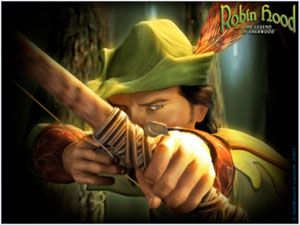 Robin Hood’s death either occurred at the hands of Guy of Gisbourne, whom the Shire Reeve of Nottingham employed as a bounty hunter, or at the hands of agents of the King, or by the Shire Reeve himself. One very common legend has Robin going to visit his cousin at a Priory to be ‘bled’ a common practice in the Middle Ages. He traveled there only with Little John and the Priory allowed to much bled to be let and Hood could not recover. John sought vengeance on the Prioress but Robin refused his request before he died because he had never harmed a woman.
 I haven’t met Paul in person yet, but we have corresponded by email. And the great thing about it for me is I feel like I’ve made a new friend. (We’ve talked about San Diego Comic Con a bit. He’s never been and I’ve told him he needs to go!) Reading his interview is a fascinating insight into how an actor prepares for a role. Having seen some his work on the screen and hearing him perform on the audios, I’ve grown doubly impressed, hearing him speak of the diligence and effort required of a performer for each type of role. As you might imagine, with writing, rewrites, edits, copy edits, galley readings and what not, by the time
  I have had the good fortune of attending many Trek Cons. It is a lot of fun. I love Trekkies as I have been a fan of the show since I was a little boy. (I still have my Kirk and Spock action figures) (
 I’ll be speaking on a panel on Sunday from 12 noon to 12:50 in room 24 ABC of the San Diego Convention Center. The panel will include a host of Young Adult authors including Christopher Pike and Kathy Reichs, creator of the television show BONES, who is writing her first YA novel. It should be a lively discussion, so if you’re going to the convention, be sure to come by. Also, all of us will be signing books after the panel in Autograph area AA. Hope to see you there.
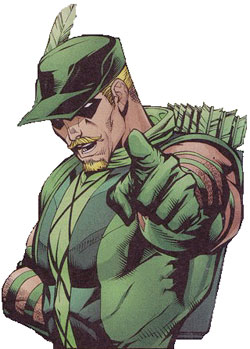
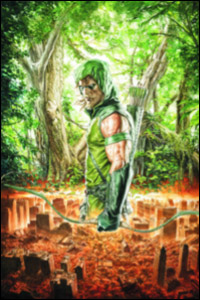 As I’ve mentioned before, the DC Comics hero Green Arrow, is a modern day version of the Robin Hood legend. Interestingly enough, GA was created by the immortal Jack Kirby to compete with Batman. In the earliest incarnations, GA had an “Arrow Cave,” drove “The Arrow Car,” had a young sidekick named “Speedy,” and instead of a utility belt had a quiver full of ‘trick arrows’ like the ‘handcuff arrow’ and the ‘boxing glove arrow.’ (The boxing glove arrow was always a personal favorite and brought many a criminal to their knees!) Oliver Queen was also a multi-billionaire, like Bruce Wayne, and took up the mantle of Green Arrow to fight crime with his exceptional archery skills.
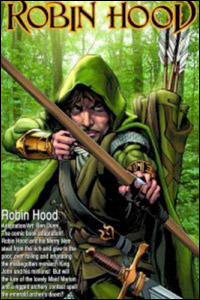 Also, out on the racks this month is a retelling of Robin Hood in comic form. Robin Hood comes from Antarctica Press and tells the story of the Outlaw of Sherwood in verse. The art is quite nice and the story is the traditional one we’re all familiar with. However the verse is a little clunky at times. But still, if you are a teacher or a librarian looking for a way to hook a reluctant reader and get them interested in the mythology of Robin Hood, either one of these books would be an excellent place to start.
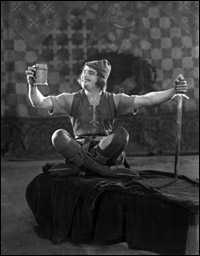 When it comes to action heroes on the big and small screens, probably no other figure has been portrayed as often as Robin Hood. From early silent films to this year’s Russell Crowe extravaganza, the Outlaw of Sherwood has captured the imagination of storytellers for centuries.
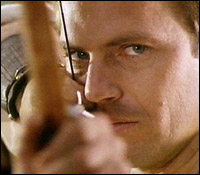 I’d like to know what your favorite theatrical version of Robin Hood is? Do you have a hankering for The Prince of Thieves with Kevin Costner as Hood? (Please say no). Or is Douglas Fairbanks or Errol Flynn more your style? Have you seen the BBC version of Robin Hood?
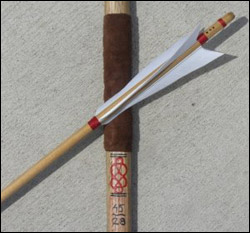 Most historians believe the longbow was developed in Wales around the time of the Norman invasion. Of course, bows had been used for hunting and warfare for centuries by then, but in Wales, a special new kind of weapon developed. Fashioned from the wood of the yew tree, these were remarkable weapons and trees were cut and the wood cured for 2-4 years before a bowyer would fashion it into a bow stave. Yew wood was used because the interior wood, or heart wood, was strong, while the outer wood was tensile and strong. The bowstrings where made of linen, hemp or what Americans would call rawhide and the English might call ‘hoppus’ at the time. The bow staves were anywhere from 4′ to 6′ feet long. Hence the name ‘Longbow.’
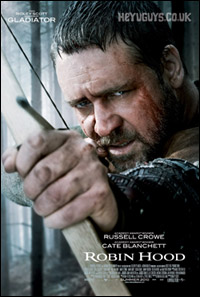 Have you visited your local cinema yet to see the new Russell Crowe starring, Ridley Scott directed Robin Hood? What did you think? As someone who has researched this time period and the individuals involved, the film doesn’t do a bad job with the history. With the exception of King Philip’s desire to invade England, which is kind of the whole third act. As far as we know, it never happened. Nor did Philip send mercenaries to England to attack the baronies and turn the baron’s against King John. Old John did a good enough job of that on his own.
 The film opens with the siege of Chalus. Richard the Lionheart is on his way home from the Crusades and has nearly bankrupted England. He is forced to try to seize this castle so that he can pay and feed his army. It does a pretty good job of depicting siege warfare and it gets it right when Richard is killed by a crossbow bolt after riding too close to the castle.
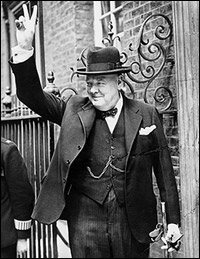 There is a
 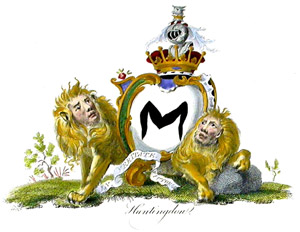 The Earldom was associated with the peerage of the King of Scotland and was passed from fathers to sons, to grandsons to nephews and fought over, ceased to exist, recreated and stamped out again. It’s quite possible that during the reign of Richard the Lionheart the disputed Earldom was claimed by Robert, who fell into disfavor with the King and his shire reeves and ministers. What makes it even more difficult, as if the English records keepers of the time wanted to torment modern historians, ‘Robin Hood’ became a common alias used by Shire Reeves and Bailiffs when they arrested someone who’s name was unknown and used as a place holder until their identity could be confirmed. Medieval records are rife with ‘Robin Hoods’ being arrested all over England.
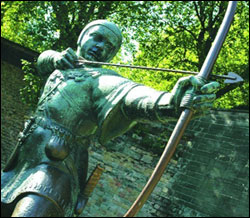 It might be impossible to overemphasize how ingrained in medieval English society the Robin Hood legend became during the high Middle Ages. Despite the confusion over his true identity, it could be argued that “Robin Hood” in all his many incarnations became the first ‘action hero’ of our culture. And because printed material was rare in the 12th and 13th century, the oral tradition of storytelling took up the exploits of everyone’s favorite outlaw and sent it across the English countryside like wildfire.
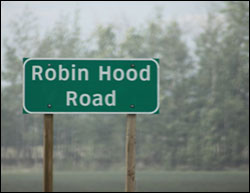 Medieval maps are dotted with references to “Robin Hood’s Well” “Robin Hood’s Glen” “Robin’s Wood” and many other references to the brave outlaw. In later years, communities and villages celebrated “Robin Hood’s Day” with plays, feasts, wrestling matches and other festivities. In all the dramatic interpretations of the time, whether staged plays in London, or comical farces on the village green, Robin easily bests the Sheriff, Guy of Gisborne (the evil Bounty Hunter) and whatever other nefarious men attempt to best him.